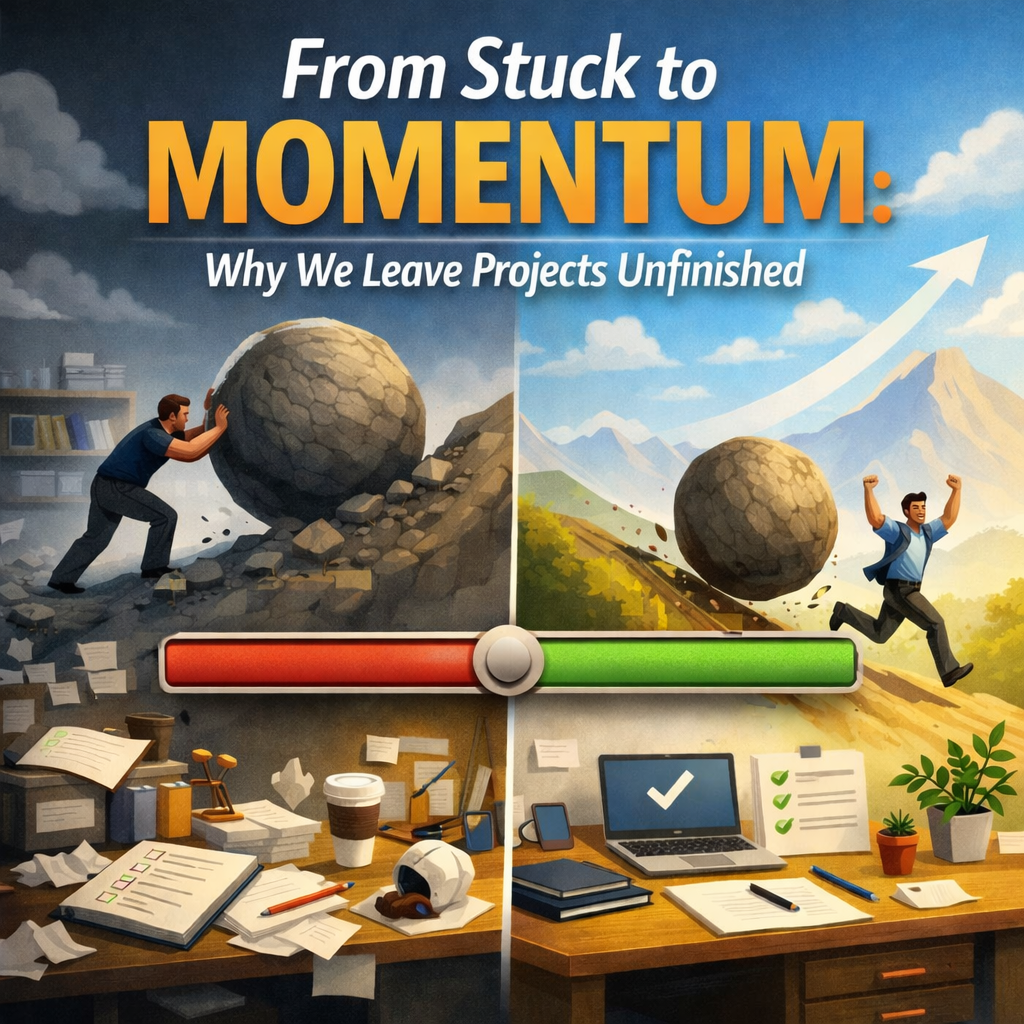
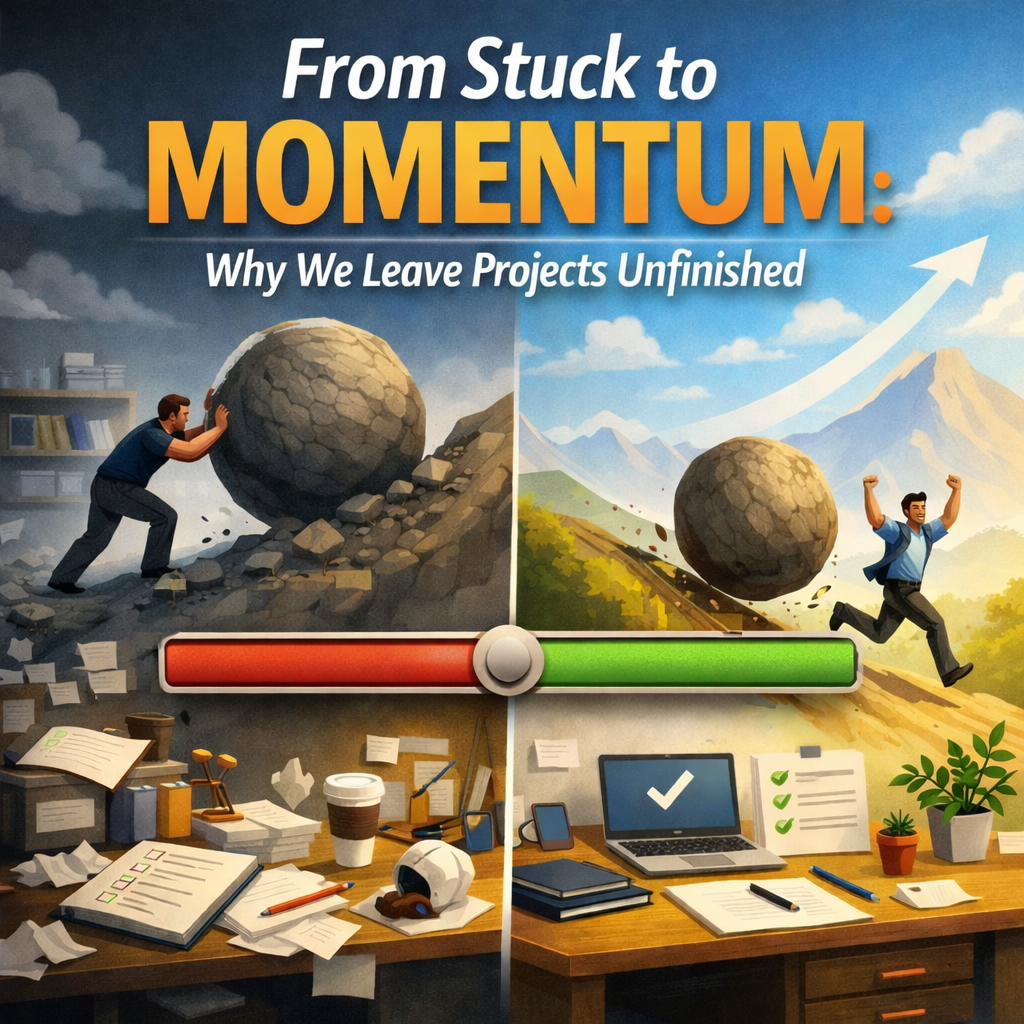
Most professionals don’t struggle because they lack ideas. They struggle because too many important projects remain half-finished.
The course you meant to complete.
The proposal you meant to refine.
The business idea that never quite moved forward.
Unfinished projects are more than a productivity issue — they are an energy drain. Each open loop quietly occupies mental space and chips away at confidence. Over time, even highly capable people begin to question their own follow-through.
The encouraging news is that this pattern is not a character flaw. It is a neurological and psychological pattern that can be rewired.
The Hidden Cost of Unfinished Work
Every unfinished project creates what psychologists call cognitive load — the mental weight of something incomplete. Your brain prefers closure. When tasks remain open, part of your attention stays tied to them.
This often leads to:
Mental clutter
Reduced focus on new priorities
Subtle background stress
Erosion of self-trust
High achievers tend to feel this tension more strongly because they often manage multiple responsibilities at once. The more open loops there are, the heavier the mental load becomes.
Over time, the internal narrative can quietly shift from “I’m capable” to “Why can’t I finish what I start?”
The Psychology of Procrastination in High Performers
Procrastination among driven professionals is rarely about laziness. More often, it is linked to one of three internal pressures:
Perfection pressure — “It has to be excellent or not at all.”
Overwhelm — “This is bigger than I expected.”
Emotional resistance — “Part of me doesn’t want to face this.”
The brain is designed to avoid perceived discomfort. If a project triggers uncertainty, fear of judgment, or cognitive overload, the nervous system naturally steers attention toward easier, more immediately rewarding tasks.
This is why intelligent, disciplined people can still find themselves stuck.
Why Finishing One Project Changes Everything
Completion builds psychological momentum.
When you finish something meaningful, your brain registers progress and reward. This strengthens neural pathways associated with follow-through and increases your willingness to tackle the next challenge.
One completed project can:
Restore self-trust
Increase motivation
Reduce mental clutter
Build visible professional credibility
Momentum is not just motivational — it is neurological. Success experiences teach the brain that effort leads to closure and reward.
From Stuck to Momentum: A Practical Framework for Finishing What You Start
A structured approach can make a significant difference when progress stalls. One practical four-stage framework includes:
1. Clarify the real block
Many unfinished projects are mislabeled as time-management problems. Often, the true barrier is emotional — perfectionism, fear of exposure, or decision fatigue. Naming the real friction point creates immediate clarity.
2. Reduce the cognitive load
Large, vague projects overwhelm the brain. Breaking work into clearly defined, psychologically manageable steps reduce resistance and increases forward movement.
3. Build structured momentum
Instead of relying on bursts of motivation, small, repeatable progress cycles create consistency. Regular forward movement trains the nervous system to associate action with safety and progress.
4. Reinforce a completion identity
A powerful shift occurs when someone begins to see themselves not as “someone who starts things,” but as “someone who finishes strategically.” Identity-level change helps sustain long-term follow-through.
Common Patterns Behind Stalled Projects
In many professional environments, unfinished work is rarely caused by lack of intelligence or effort. More commonly, it is linked to:
Too many open loops competing for attention
Unstructured or overly ambitious planning
Hidden perfection pressure
Lack of external structure or reflection
When these factors are addressed, progress often becomes smoother and more predictable.
How Coaching Can Support Sustainable Follow-Through
While personal effort is essential, many professionals find it easier to maintain momentum when there are structured guidance and accountability in place.
A well-designed coaching process can help individuals:
Identify the real psychological friction behind delays
Create realistic and strategically sequenced action plans
Strengthen emotional regulation around challenging tasks
Maintain focus during the difficult middle phase of projects
Turn follow-through into a repeatable professional habit
Rather than relying on short bursts of motivation, the focus shifts toward building systems that support consistent completion.
A Final Invitation
If unfinished projects have been quietly draining your energy or focus, it may be worth taking a more structured approach. Finishing what you start is not simply about willpower — it is a skill that can be developed deliberately.
For those who want a more guided and systematic path toward stronger follow-through, coaching can provide the structure, clarity, and accountability that many professionals find valuable.
Sometimes the breakthrough is not working harder — it is working with a better framework.
